Biological databases and resources
Bioinformatics · Universitat Politècnica de Catalunya
Database Organization and Abstraction Levels
Nucleotide
Protein Sequence
Protein Structure
Genetic Variability
Expression
Disease
Metabolic/Proteic Pathways
In-level (nucleotide \leftrightarrows nucleotide)
Cross-level (nucleotide \leftrightarrows protein)
Database access
Databases can be accessed locally or online.
Most DBs offer a dual access (web based, API services).
There are two main types of DBs access.
Limited Access
Human access. Exploratory queries. Few queries.
Massive Access
Mostly used in cross-reference.
Massive programmatic access.
Some DBs limit the access/IP/hour.
Most can be downloaded.
Database Types
Primary Data
Raw experimental results.
Initial interpretation (Nucleotide sequences).
Protein sequence records. Reviewed annotations add a derived layer of interpretation.
Derived or Secondary Data
Collection of conserved protein motifs.
Aggregation of Primary databases.
Results are very specific of query time. Is the database updated regularly?
Ontology Databases
Formal and explicit specifications of the terms used, and the relationship between them.
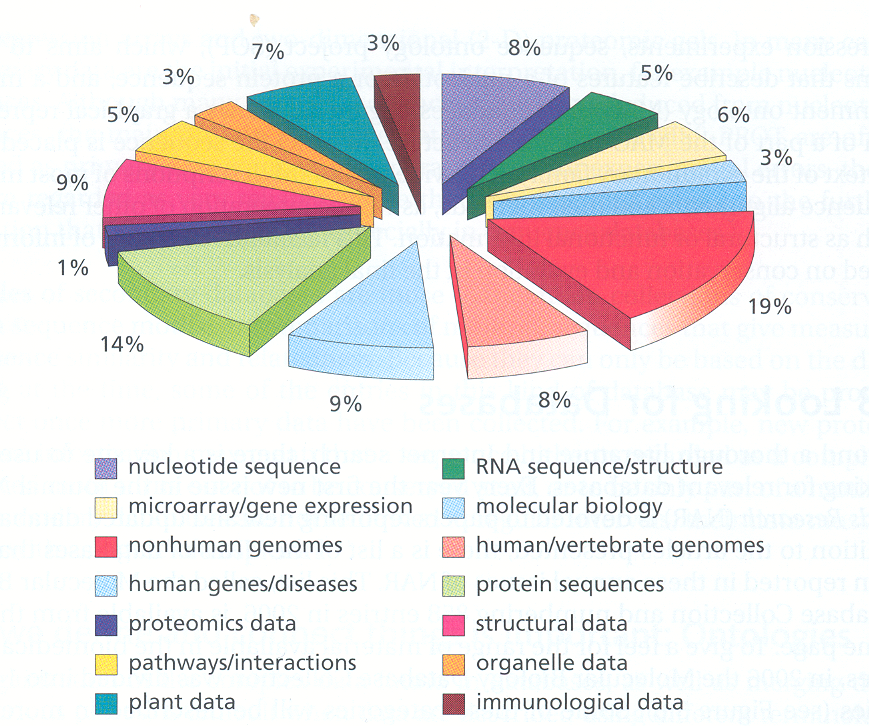
Distribution of the Type of DBs
Annotation quality
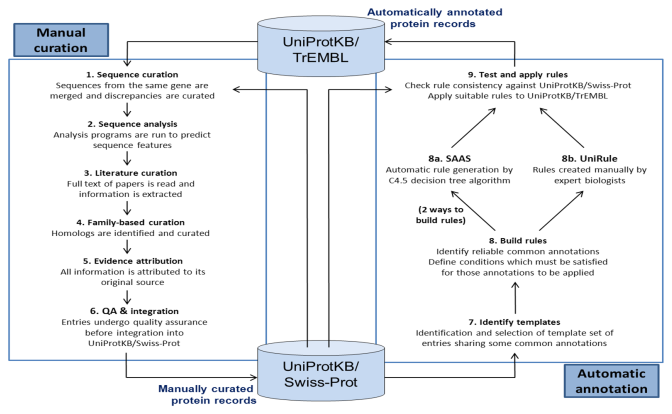
- Automated annotation transfers or predicts information using defined computational evidence.
- Manual curation evaluates evidence and resolves inconsistencies.
- Assess the evidence type, provenance, and limitations of each annotation.
- Neither the annotation method nor the database name alone guarantees correctness.
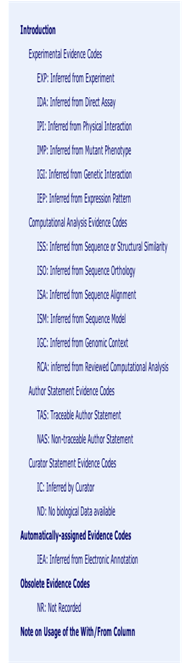
Evidence Codes (The Gene Ontology Example)
Uniprot Curation Scheme
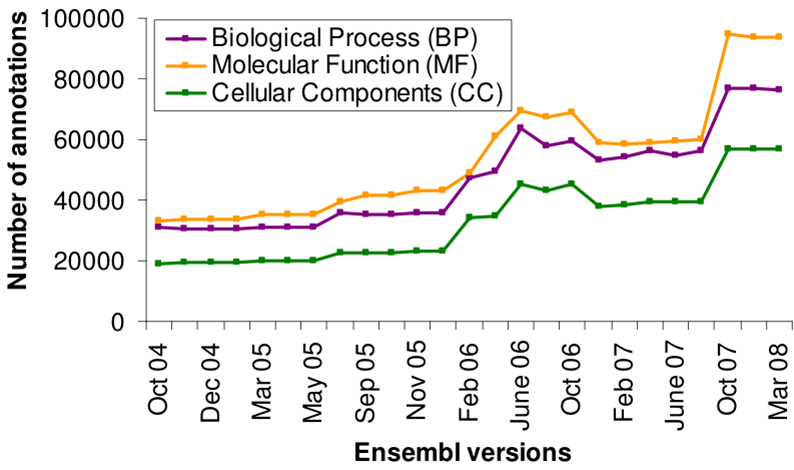
Evolution of Annotations in Ensembl
from Groß et al. 2009
Evolution of Annotation in Swiss-Prot
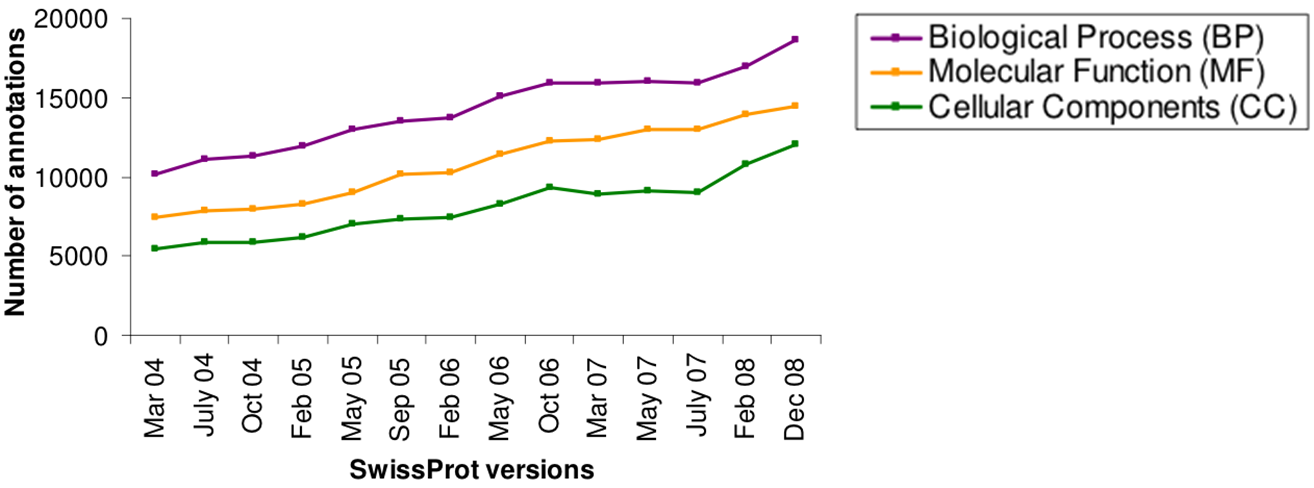
from Groß et al. 2009
Evolution of ECs in Swiss-Prot
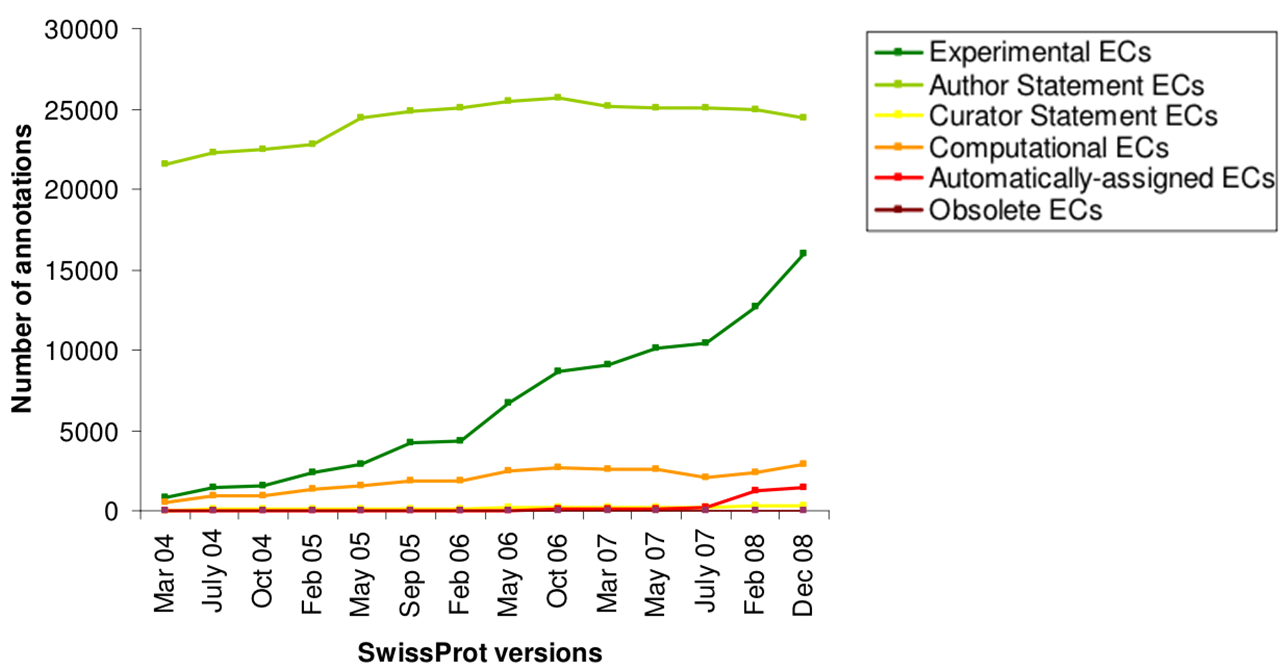
from Groß et al. 2009
Evolution of ECs in EMBL
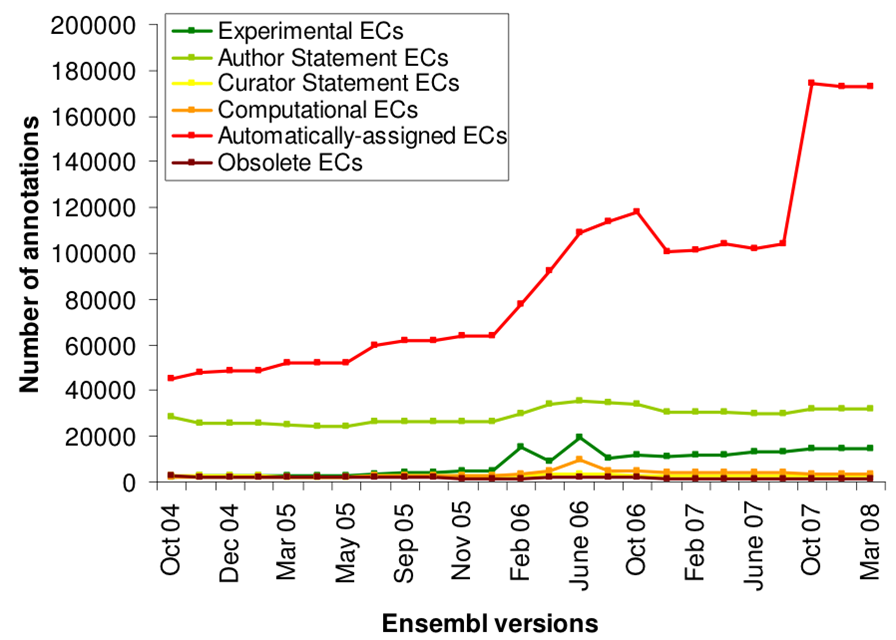
from Groß et al. 2009
Evidence and annotation scope
- Compare resources using the same organisms, sequence types, and annotation categories.
- UniProtKB/Swiss-Prot contains reviewed protein records.
- Ensembl provides genome annotation, including computationally generated gene models.
- For a functional claim, inspect the supporting evidence rather than comparing raw annotation counts.
Sequence Databases
RAW Genomic Sequences
Sequence of chromosomal DNA.
Derived from genome sequencing projects (GenBank).
cDNAs
Sequences of DNA molecules that have been synthesized by reverse transcription of mRNA molecules).lack any intronic/control sequences related to the gene.
Expressed Sequence Tags (ESTs)
An EST is a partial cDNA sequence.
A library of EST, indicates the range of genes being expressed in a sample.
Nucleotide Conventions (1/3)
| Symbol | Meaning | Origin of designation |
|---|---|---|
| G | G | Guanine |
| A | A | Adenine |
| T | T | Thymine |
| C | C | Cytosine |
| R | G or A | puRine |
Nucleotide Conventions (2/3)
| Symbol | Meaning | Origin of designation |
|---|---|---|
| Y | T or C | pYrimidine |
| M | A or C | aMino |
| K | G or T | Keto |
| S | G or C | Strong interaction (3 H bonds) |
| W | A or T | Weak interaction (2 H bonds) |
Nucleotide Conventions (3/3)
| Symbol | Meaning | Origin of designation |
|---|---|---|
| H | A or C or T | not-G, H follows G in the alphabet |
| B | G or T or C | not-A, B follows A |
| V | G or C or A | not-T (not-U), V follows U |
| D | G or A or T | not-C, D follows C |
| N | G or A or T or C | aNy |
RefSeq accession prefixes
RefSeq accessions have an underscore after the two-letter prefix.
| Prefix | Common meaning |
|---|---|
NC_ |
Complete genomic molecule |
NM_ / NR_ |
RefSeq mRNA / non-coding RNA |
NP_ |
RefSeq protein |
XM_ / XR_ / XP_ |
Computational model transcript / protein |
The accession version identifies a specific sequence version.
Assignment (1/2)
Please elaborate a description of the following databases:
The Gene Ontology Project (http://www.geneontology.org/)
Human Gene Mutation Database (HGMD) (http://www.hgmd.cf.ac.uk)
Gene Cards (http://www.genecards.org)
The Mouse Genome Informatics (http://www.informatics.jax.org)
Protein Structure Classification CATH (http://www.cathdb.info/)
NCBI Short Genetic Variations Database (dbSNP) (https://www.ncbi.nlm.nih.gov/snp/)
Human Phenotype Ontology (https://hpo.jax.org)
PRINTS Database (Protein Fingerprints) (http://bioinf.man.ac.uk/dbbrowser/PRINTS/)
Kyoto encyclopedia of Genes and Genomes (just PATHWAY Section) (http://www.genome.jp/kegg/)
Assignment (2/2)
Database of Genomic Variants (http://projects.tcag.ca/variation/)
Reactome (https://reactome.org)
STRING - Known and Predicted Protein-Protein Interactions (http://string-db.org/)
BioGRID - Biological General Repository for Interaction Datasets (http://thebiogrid.org/)
OMIM - Online Mendelian Inheritance in Man (https://www.omim.org)
Pfam protein families in InterPro (https://www.ebi.ac.uk/interpro/entry/pfam/)
Assignment
Slides (8’ each + questions)
Describe the following items for your database (if applicable).
Historic remark, research group/company, url, purpose, primary/secondary.
Database architecture and organization.
Annotation Statistics.
Annotation format, main IDs description.
Entry example/s description.
Curation (manual, automatic, evidence codes or levels).
Programmatic access (webservice, location, available software packages for remote access).
Access conditions/license.
EMBOSS
EMBOSS
The European Molecular Biology Open Software Suite. EMBOSS is a free Open Source software analysis package specially developed for the needs of the molecular biology (e.g. EMBnet) user community.
The software automatically copes with data in a variety of formats and even allows transparent retrieval of sequence data from the web.
Extensive libraries are provided with the package, it is a platform to allow other scientists to develop and release software in true open source spirit.
EMBOSS also integrates a range of currently available packages and tools for sequence analysis into a seamless whole. EMBOSS breaks the historical trend towards commercial software packages
EMBOSS
EMBOSS applications
Sequence alignment .
Rapid database searching with sequence patterns.
Protein motif identification, including domain analysis
EST analysis
Nucleotide sequence pattern analysis, for example to identify CpG islands.
Simple and species-specific repeat identification
Codon usage analysis for small genomes
Rapid identification of sequence patterns in large scale sequence sets.
Presentation tools for publication.
…
Bioweb2
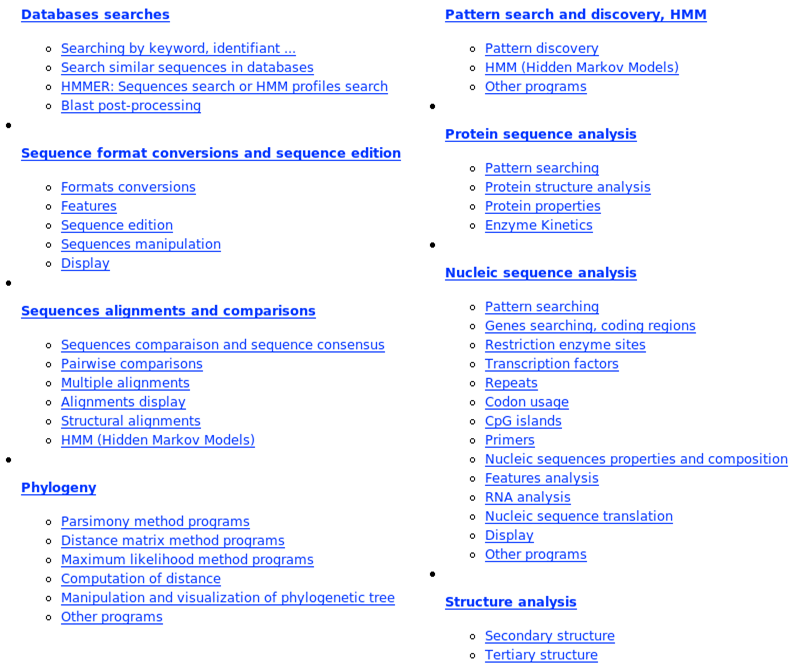
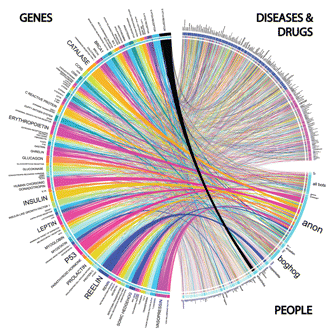
NAR Database Issue
Annual Database Issue of Nucleic Acids Research
Bio-computing Languages
Bio-Perl.
Bio-Java.
Bio-Python.
R, through Bioconductor.
Perl
PERL
Perl is a general-purpose language with a long history in text processing.
http://perl.org
Interpreted.
Some features similar to UNIX shell.
Some other features extracted from AWK, regexp and sed.
Automatic memory-management.
Extremely fast on text processing.
Classic language for CGI-scripting on web.
Also used in finance and bioinformatics.
BioPerl
BioPerl is a toolkit of perl modules useful in building bioinformatics solutions in Perl.
http://bioperl.org
Object oriented.
bioperl-live repository consists of the core of the functionality of bioperl.
bioperl-db persistent storage in RDMBS.
bioperl-gui auxiliary modules for creating graphical interfaces.
bioperl-pipeline software to automate bioinformatic analyses.
bioperl-pedigree objects for Pedigrees, Individuals, Markers, & Genotypes.
GC content across FASTA records
from Bio import SeqIO

records = list(SeqIO.parse("data/example.fa", "fasta"))
total = sum(len(r) for r in records)
if total == 0:
    raise ValueError("No sequence bases found")
gc = sum(str(r.seq).upper().count(b)
         for r in records for b in "GC")
print(f"Total bases: {total}")
print(f"GC content: {100 * gc / total:.1f}%")
This is a Python example. It includes ambiguous symbols in the denominator.
BioJava
BioJava is
A open source project dedicated to providing a Java framework for processing biological data.
http://biojava.org
Manipulating biological sequences, file parsers.
DAS client and server support.
Access to BioSQL and Ensembl databases.
Tools for making sequence analysis GUIs.
Powerful analysis and statistical routines including a dynamic programming toolkit.
Web programming, multiplatform.
GC content with BioJava
This example uses the modern org.biojava.nbio namespace. For FASTA files, use BioJava’s FastaReaderHelper.
Biopython
Python
Powerful dynamic programming language (“batteries included”)
http://python.org
Very clear, readable syntax.
Intuitive object orientation
Natural expression of procedural code
Full modularity, supporting hierarchical packages
Very high level dynamic data types
Extensive standard libraries and third party modules for virtually every task.
Extensions and modules easily written in C, C++ (or Java for Jython, or .NET languages for IronPython)
Embeddable within applications as a scripting interface
Biopython
Biopython provides Python tools for working with biological data.
- Read and write sequence files with
Bio.SeqIO. - Represent sequences and annotated records.
- Read, compare, and construct alignments.
- Work with substitution matrices and structural data.
- Access NCBI services through the relevant interfaces.
- Store annotated sequences through BioSQL integration.
Biopython Tutorial and Cookbook
Biopython Tutorial and Cookbook, By Jeff Chang, Brad Chapman, Iddo Friedberg, Thomas Hamelryck, Michiel de Hoon, Peter Cock, Tiago Antao, Eric Talevich, Bartek Wilczyński.

GC content in Python
The denominator includes all symbols. Ambiguous bases contribute to length but not to the G + C count.
For "aCgTN", the GC content under this convention is 40%.
Reading genome annotations with Biopython
from Bio import SeqIO
from Bio.Graphics import GenomeDiagram
from reportlab.lib import colors

record = SeqIO.read("data/NC_005816.gb", "genbank")
diagram = GenomeDiagram.Diagram(record.id)
track = diagram.new_track(1, name="Coding sequences")
features = track.new_set()

for feature in record.features:
    if feature.type == "CDS":
        features.add_feature(feature, color=colors.teal)
SeqIO.read() expects one record. Use SeqIO.parse() for a file containing several records.
Drawing a genome diagram
The diagram uses the annotated coding-sequence coordinates in the GenBank record.
R and Bioconductor


The End


Bioinformatics · UPC · b2slab