Epigenetic biomarkers can predict the success of weight-loss interventions in pre-pubertal children with obesity
Childhood obesity and the challenge of personalised treatment
Childhood obesity represents one of the most pressing public health challenges of our time. Approximately 80% of children with overweight or obesity will remain obese into adulthood, significantly elevating their long-term risk of type 2 diabetes, cardiovascular disease, and other serious comorbidities. Lifestyle interventions — combining dietary counselling and moderate physical activity — remain the primary clinical strategy. Yet their outcomes are markedly heterogeneous: some children respond well and achieve sustained reductions in body weight, while others do not, despite comparable levels of adherence.
This variability underscores a critical need for predictive tools capable of identifying, before an intervention begins, which children are most likely to benefit. Currently, no reliable biomarkers exist for this purpose in the paediatric population.
A collaborative study linking epigenomics to intervention outcomes
A new study published in Clinical Epigenetics addresses this gap directly. Led by Flavio Palmieri (B2SLab, IRIS — Universitat Politècnica de Catalunya) in close collaboration with Josep C. Jiménez-Chillarón (Biophysics Unit, Department of Physiological Sciences, School of Medicine, University of Barcelona, L’Hospitalet de Llobregat, Spain), the work investigates whether baseline DNA methylation profiles — measured before any intervention — can forecast a child’s response to a six-month moderate lifestyle programme.
The study analysed a cohort of 26 pre-pubertal children with obesity (7–10 years of age), recruited at the Sant Joan de Déu Barcelona Children’s Hospital. Children were classified as High Responders (HR) or Low Responders (LR) according to the change in their age- and sex-standardised BMI z-score (ΔzBMI) over the intervention period.
From 850,000 CpG sites to eight predictive markers
Using whole-blood DNA methylation data from the Infinium Methylation EPIC 850K array, the team profiled nearly 850,000 CpG sites per subject. After rigorous quality control and preprocessing — including correction for batch effects and estimated leukocyte composition — 788,373 CpGs were available for statistical analysis.
Differential methylation analysis using leave-one-out (LOO) regression identified 214 CpG sites consistently associated with the HR/LR classification at baseline. Crucially, the intervention itself did not alter the global DNA methylation landscape, confirming that these markers reflect pre-existing epigenetic differences and not adaptive responses to the programme.
To arrive at a clinically applicable model, the team iteratively reduced the 214 candidate markers to a minimal predictive subset using partial least squares (PLS) regression. The final model comprises eight CpG sites, including markers in or near the genes GSDMD, GFRA1, NRP2, NLRC5, SPTLC2, and LTBP3 — genes implicated in inflammatory regulation, metabolic signalling, and lipid metabolism.
A predictive model with 84% classification accuracy
The eight-marker PLS model achieves an area under the ROC curve (AUC) of 84%, with a sensitivity of 77% and a specificity of 85% at the optimal classification threshold. On the study cohort, the model correctly classified all children in the Low Responder group and misclassified only two High Responders — a strong performance given the modest cohort size.
Biological insight: sphingolipid metabolism as a key pathway
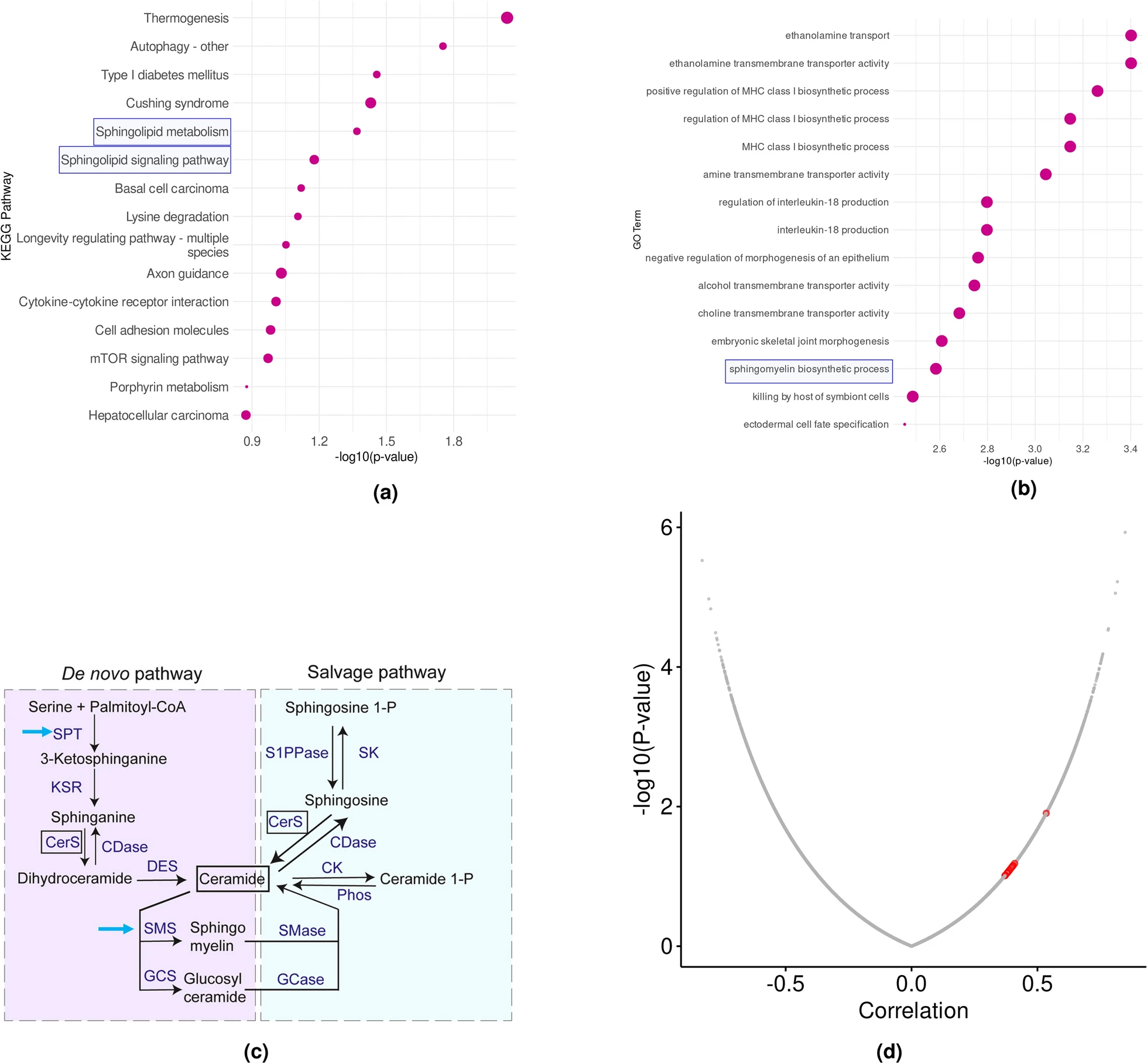
Beyond predictive accuracy, the study provides important biological context. An enrichment analysis of the 214 prioritised CpG sites consistently highlighted the sphingolipid metabolism pathway in both KEGG and Gene Ontology databases. Two of the eight final predictive markers — SPTLC2 (Serine Palmitoyltransferase Long Chain Base Subunit 2) and SGMS1 (Sphingomyelin Synthase) — are rate-limiting enzymes in the de novo synthesis of ceramides and sphingolipids.
An integrative epigenomics–metabolomics analysis further revealed that the methylation of the SPTLC2-associated CpG site correlates significantly with plasma ceramide levels, which in turn respond to the lifestyle intervention. These findings position sphingolipid regulation as a molecular link between epigenetic predisposition and individual metabolic responsiveness in childhood obesity.
Implications for personalised paediatric medicine
The results demonstrate, for the first time, that a compact DNA methylation signature measurable from peripheral blood can stratify pre-pubertal children with obesity according to their likely response to a lifestyle intervention — before the intervention is initiated. Because blood-based DNA methylation can be measured reliably, non-invasively, and at relatively low cost, this approach is compatible with clinical workflows.
The authors emphasise that broader, more diverse cohort studies are required to validate the generalisability of these eight markers and to refine the model for routine clinical use. Nevertheless, the study establishes a clear proof of concept and provides a foundation for the development of personalised treatment strategies in paediatric obesity.
This work is the result of a productive collaboration between B2SLab and the group of Josep C. Jiménez-Chillarón at the University of Barcelona, and reflects the laboratory’s ongoing commitment to integrating epigenomics, metabolomics, and machine learning for translational biomedical research.
Reference: Palmieri F, Castellano-Escuder P, Parra-Vargas M, Leal-Witt MJ, Ramón Krauel M, Lerin C, Perera A, Jiménez-Chillarón JC. Predictive epigenetic biomarkers of successful weight-loss intervention in pre-pubertal children with obesity. Clinical Epigenetics (2026) 18:108. https://doi.org/10.1186/s13148-026-02104-1