Automating methane flux analysis with MethaneSignalProcessor
Understanding methane (CH\(_4\)) emissions from aquatic ecosystems is essential for improving greenhouse gas budgets and gaining insight into ecosystem functioning. However, methane is released through two very different processes—diffusion and ebullition—which are often mixed in high-frequency sensor data and difficult to separate.
In our recent work, we introduce MethaneSignalProcessor (MSP), an open-source computational pipeline designed to automatically distinguish and quantify these two emission pathways from CH\(_4\) time-series data.
The method combines signal processing techniques—including filtering, adaptive peak detection, and a dual-branch correction strategy—to reconstruct a diffusion-dominated baseline while isolating transient bubble events. This allows the estimation of diffusive fluxes across multiple segments of the signal, rather than relying on a single pre-disturbance window.
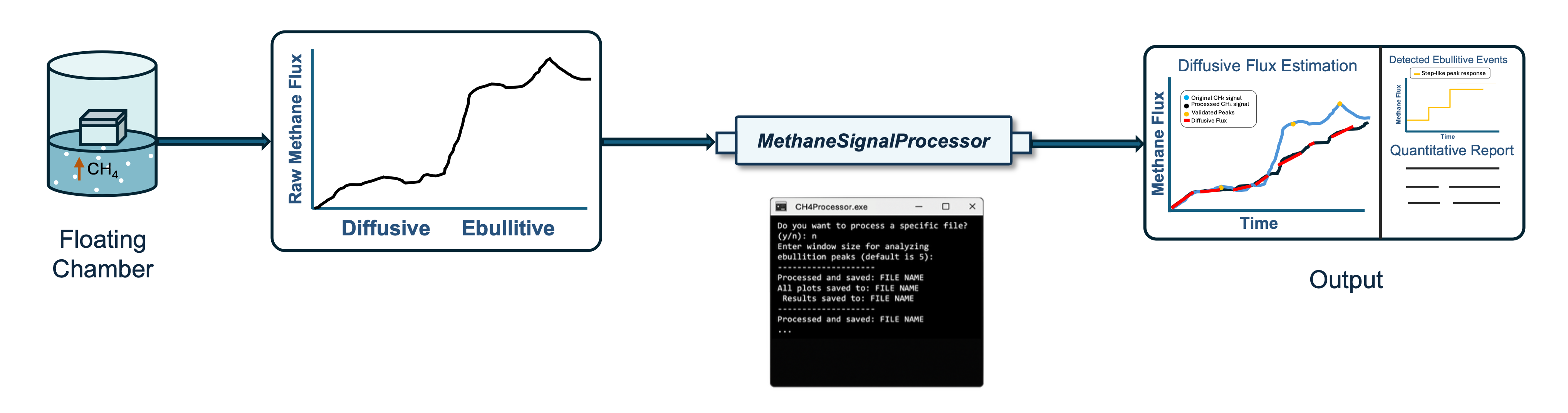
To evaluate its robustness, MSP was applied to datasets collected under very different environmental conditions, including a tropical soda lake in Kenya and temperate freshwater systems in Denmark. Despite differences in sensor configurations, chamber designs, and environmental variability, the pipeline consistently separated diffusive trends from ebullitive dynamics and provided physically plausible flux estimates.
One key advantage of MSP is that it operates without manual parameter tuning. Instead, it adapts automatically to the statistical properties of each signal, enabling reproducible analysis across heterogeneous datasets.
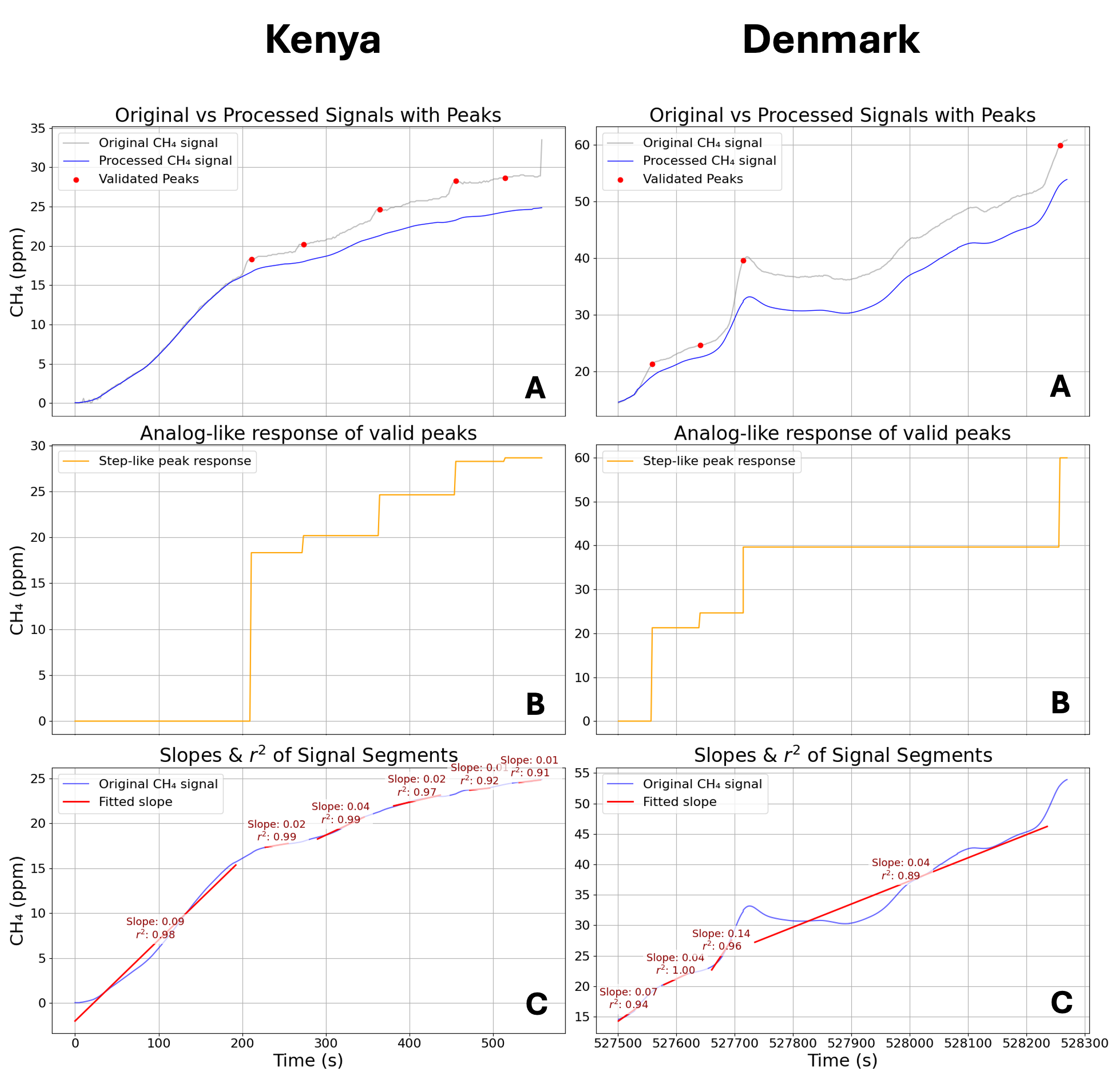
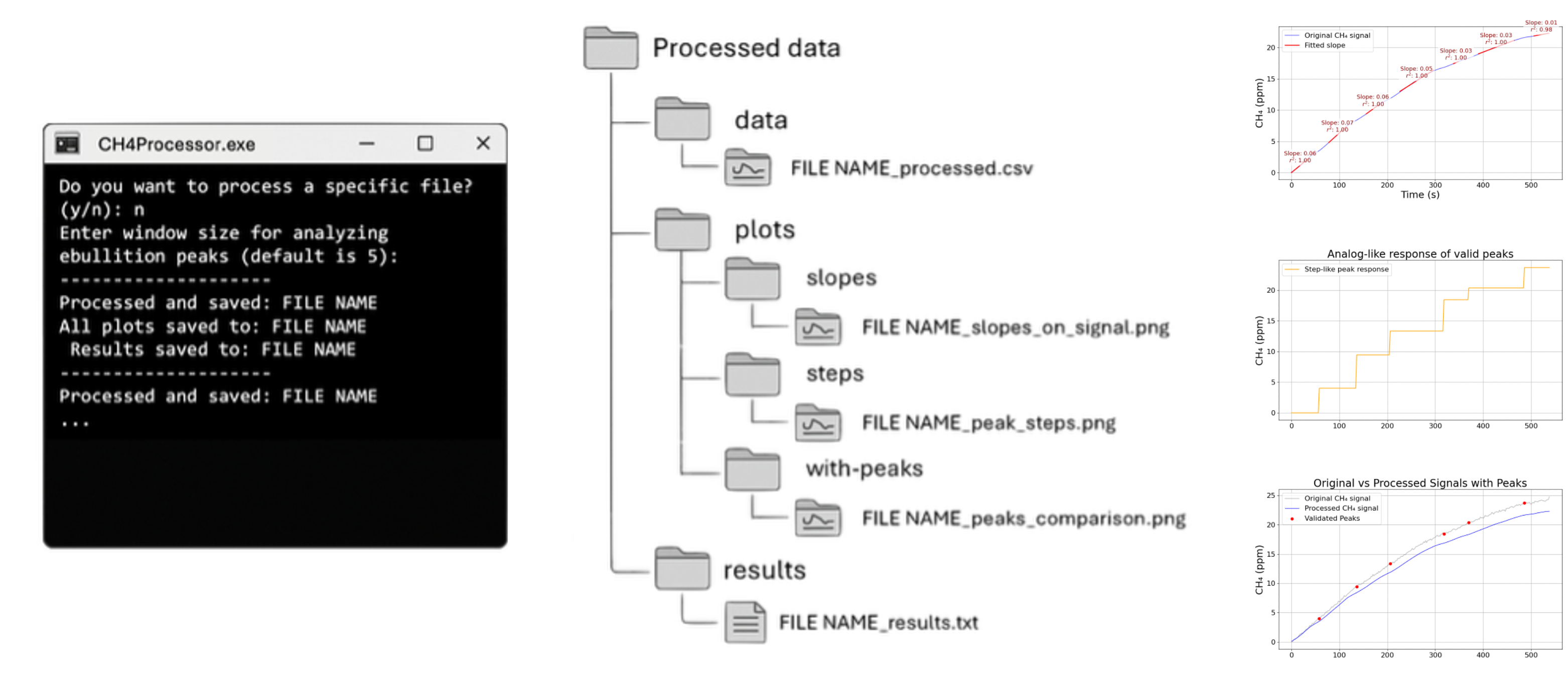
By providing both graphical outputs and quantitative metrics, MSP facilitates the interpretation of methane emission dynamics and supports the integration of high-frequency sensor data into environmental monitoring workflows.
The code is openly available and includes both a Python implementation and a user-friendly executable, making it accessible to a wide range of users working on aquatic greenhouse gas emissions.
We expect this tool to contribute to more standardized and scalable analysis of CH\(_4\) fluxes, particularly as continuous sensing technologies become more widely adopted in environmental research.
The paper is available at: Cardona, A., Butturini, A. and Fonollosa, J. (2026) “MethaneSignalProcessor (MSP): Automated discrimination of diffusive and ebullitive methane fluxes at the water–air interface from time-series data,” Ecological Informatics, p. 103781. Available at: https://doi.org/10.1016/J.ECOINF.2026.103781.