Where you put your CO2 sensor in a classroom can matter more than which sensor you buy
The CO2 sensor boom and what followed
The COVID-19 pandemic brought CO2 monitoring into mainstream conversation. Carbon dioxide concentration is a practical proxy for ventilation quality and the accumulation of exhaled air — and therefore for the risk of airborne transmission of respiratory pathogens. In response, schools, offices, and public buildings across Europe began installing low-cost CO2 sensors in large numbers.
But once sensors were on walls across the continent, a practical question emerged: are the readings reliable? And does it actually matter where you put the device?
A systematic measurement campaign
In a study published in Indoor Air, our team conducted a careful measurement campaign across primary schools and university classrooms in Catalonia. Over five months, we performed 33 individual measurements in rooms with different topologies and ventilation systems — natural ventilation, mechanical ventilation, and mixed systems.
Rather than simply comparing sensor readings to a reference, we used the rate of change of CO2 (dCO2/dt) as a diagnostic tool. This approach allows tendencies in CO2 evolution to be tracked in a way that is sensitive to the local airflow environment around a sensor — not just the average room concentration.
What the data showed
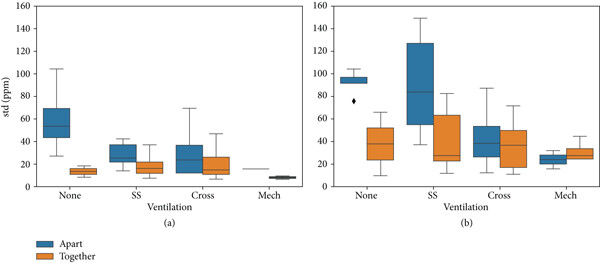
The results were striking in their practical implications. Sensor position and ventilation strategy caused spatial CO2 discrepancies exceeding 100 ppm in many measurement scenarios — a difference that in many guidelines would shift a room from acceptable to concerning ventilation status.
Critically, these differences were larger and more systematic than the variation between sensor models from different manufacturers. In other words, buying a more expensive sensor does not help you if it is placed in the wrong spot.
Specific findings included:
- Sensors placed near supply air inlets (where fresh air enters) consistently read lower concentrations than those near return air vents or occupied zones.
- In naturally ventilated rooms, CO2 distribution was highly non-uniform and dependent on window openings — making single-point measurements particularly unreliable.
- In mechanically ventilated rooms, sensor position relative to the airflow path had a systematic and predictable effect on readings.
Practical recommendations
The study derives concrete guidelines for future measurements:
- Avoid placing sensors near air supply inlets or directly in the path of draught from open windows.
- In mechanically ventilated rooms, sensor position relative to supply and return vents should be documented and reported alongside measurements.
- For classroom monitoring intended to represent occupant exposure, sensors should be positioned in the occupied zone at breathing height.
These recommendations are particularly relevant for schools, where CO2 monitoring is increasingly mandated by health authorities — but standards for sensor placement remain inconsistent or absent.
The paper is available at: Marín D, Ruiz de Alegria A, Canals Casals L, Macarulla M, Fonollosa J. The reliability of CO2 measurements using low-cost sensors: a study of sensor positioning and ventilation strategies in classrooms. Indoor Air, 2025. https://doi.org/10.1155/ina/5517242