Reading the molecular signature of colon polyps before they turn into cancer
From polyp to cancer: a window of opportunity
Colorectal cancer (CRC) is one of the most common cancers worldwide, but it has an important characteristic that distinguishes it from many other malignancies: it almost always passes through a precancerous stage first. Around 85% of colorectal cancers develop from adenomas — benign polyps that form in the lining of the colon and, if left undetected, can progress to invasive cancer over years.
This stepwise progression is both a warning and an opportunity. If we can detect and characterise adenomas early enough — and better understand which ones are more likely to progress — we can intervene before cancer takes hold.
Not all polyps are the same
Adenomas come in three main histological subtypes — tubular, tubulovillous, and serrated — which are known to carry different risks of malignant transformation. Tubular adenomas are the most common and generally lower-risk; serrated adenomas follow a distinct molecular pathway and are more likely to be missed during colonoscopy; tubulovillous adenomas combine features of both.
Despite these clinical differences, the molecular signatures that underlie them had not been comprehensively mapped. In a study published in Cancers, our group — together with collaborators at UniversalDx — performed a detailed multi-omic characterisation of these three subtypes.
Three molecular layers, three stories
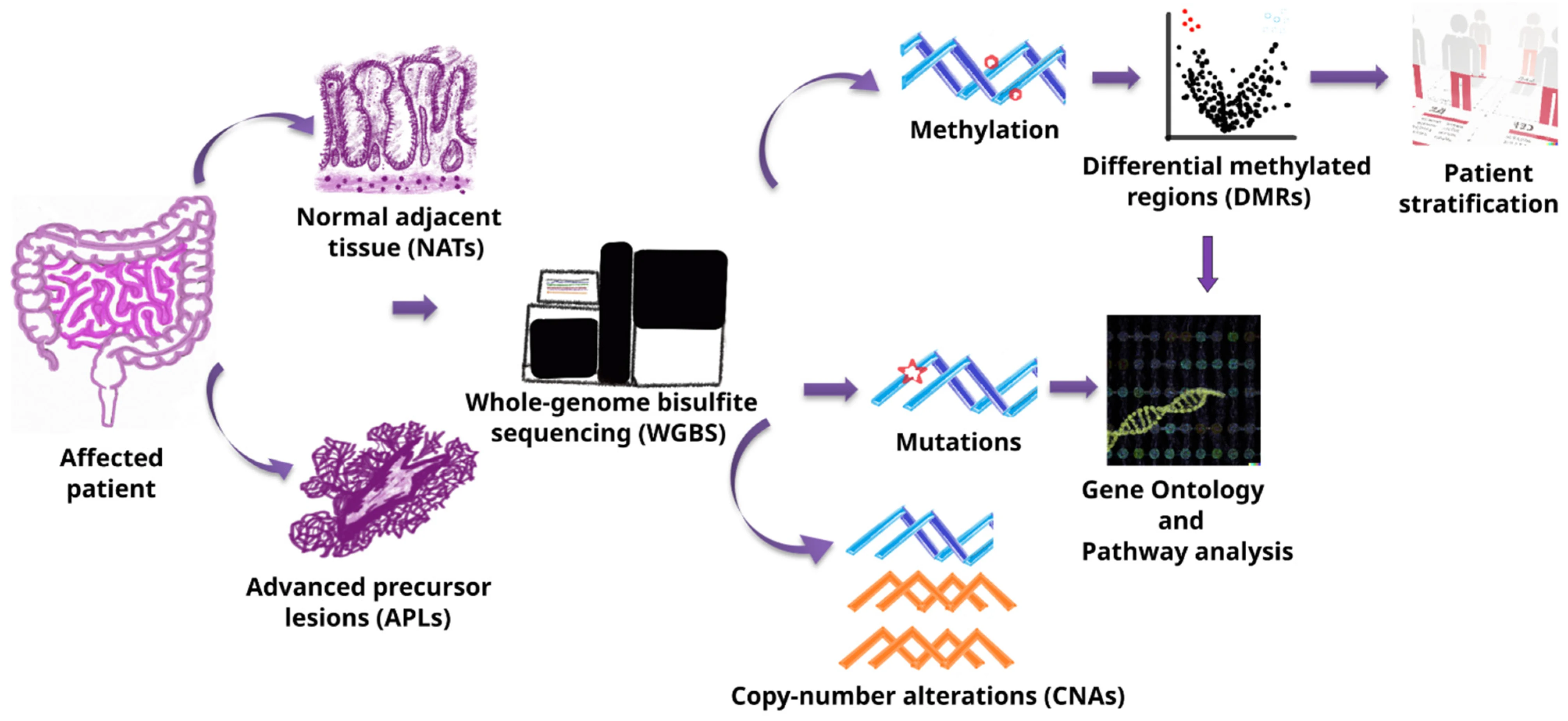
We analysed methylation, copy-number alterations (CNA), and somatic mutations across the adenoma subtypes, in the context of the progression from normal colon tissue through advanced precancerous lesions (APLs) to early-stage CRC.
The results reveal distinct molecular identities at each layer:
Methylation showed 2,321 significantly altered regions across subtypes. Serrated adenomas were enriched for changes in cAMP signalling and stem cell pluripotency pathways — consistent with their unique biological behaviour. Tubular and tubulovillous adenomas showed enrichment for WNT signalling, one of the most studied cancer pathways.
Copy-number alterations were predominantly found in tubular and tubulovillous adenomas, with recurrent signals in chromosomes 7, 12, 19, and 20. Importantly, the CNA profile of early-stage CRC differed — chromosomes 7, 8, and 20 — suggesting that the progression from APL to carcinoma involves distinct genomic events, not just more of the same.
Mutations reinforced the subtype-level differences, with specific alterations characteristic of each histological class.
Why this matters for early detection
These molecular signatures are precisely the kind of information that early detection tests need. Whether blood-based, stool-based, or tissue-based, a test that can distinguish adenoma subtypes and estimate progression risk could dramatically improve how we triage patients — reducing unnecessary colonoscopies for low-risk individuals while prioritising those with high-risk adenomas.
The findings also contribute to the emerging picture of colorectal cancer as a collection of molecularly distinct diseases rather than a single entity, each subtype potentially requiring different surveillance strategies.
The paper is available at: Mattia F, Higareda J, Canal P, Bertossi A, Perera A, Herbert M, Kruusmaa K. Colorectal adenoma subtypes exhibit signature molecular profiles: unique insights into the microenvironment of advanced precancerous lesions for early detection applications. Cancers, 2025. https://doi.org/10.3390/cancers17040654