What happens to your genes when you run a marathon? We looked at 60 runners to find out
Running 42 km is a molecular event
Most people know that running a marathon is physically demanding. But what does it actually do inside your cells? Beyond the tired legs and elevated heart rate, the body is executing a massive molecular response — one that we are only beginning to map at the level of gene expression.
In a new study published in Biology of Sport, we followed 60 non-elite marathon runners and profiled the transcriptome of their whole blood at three time points: before the race, immediately after crossing the finish line, and 24 hours into recovery.
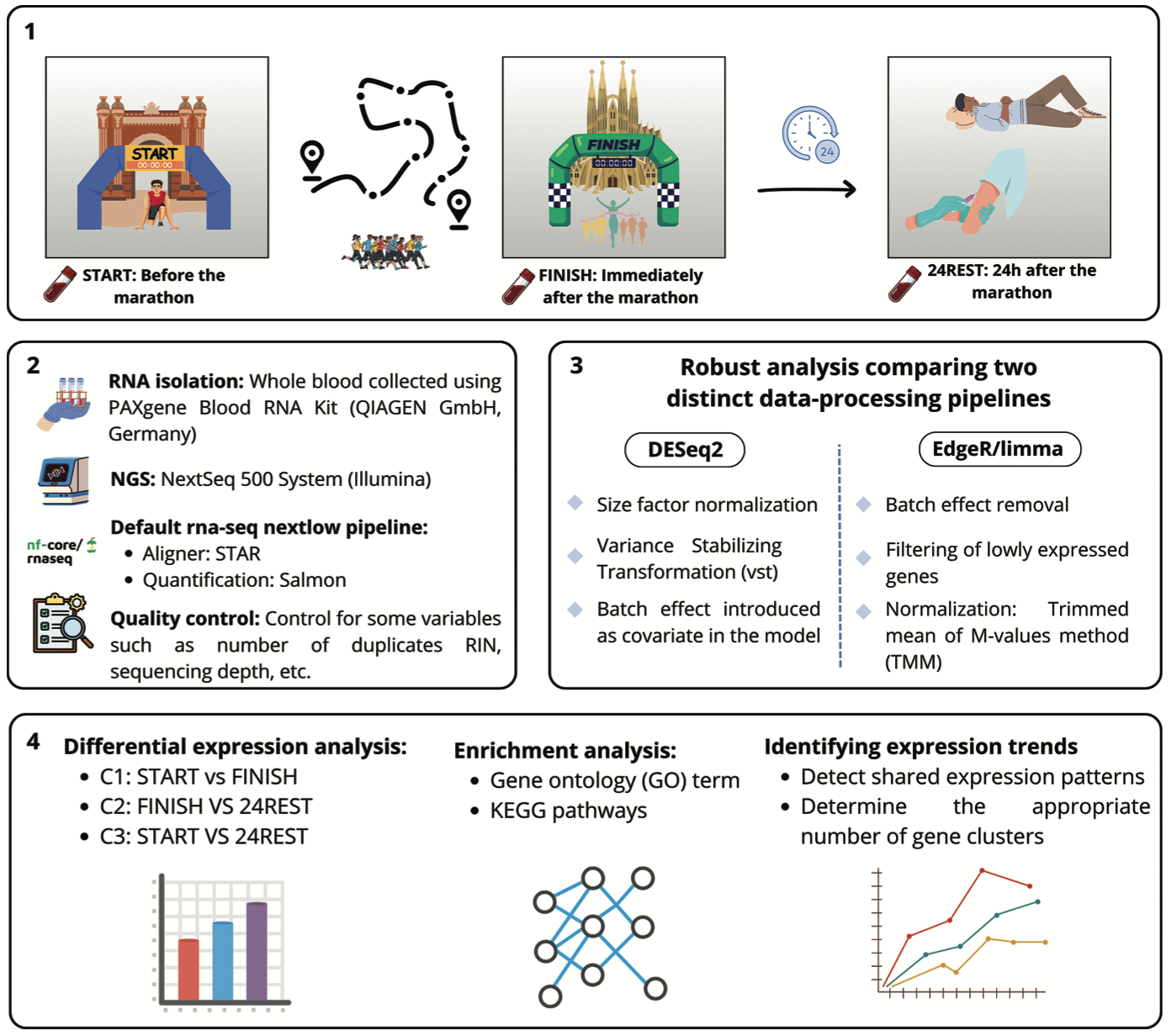
Nearly 10,000 genes respond to a single race
The scale of the response was striking. Immediately after finishing, we found 9,874 differentially expressed genes compared to the pre-race baseline. This is a substantial fraction of the expressed genome — the body is not making small adjustments; it is undergoing a broad molecular reorganisation.
The major pathways activated immediately after the race were:
- Immune system mobilisation — strong up-regulation of inflammatory and innate immune pathways, consistent with the physical trauma of sustained exertion.
- Oxidative stress response — genes involved in counteracting reactive oxygen species, produced in large amounts by working muscles.
- Lipid metabolism — shifts in how the body processes fat, reflecting the switch to fat oxidation that occurs during prolonged endurance exercise.
These responses are not surprising in isolation — we knew exercise activates them. What the study adds is a genome-wide, unbiased view of their magnitude and co-occurrence in real-world non-professional athletes.
The body hasn’t recovered 24 hours later
Perhaps the most interesting finding is what happens the day after. Twenty-four hours post-race, most gene expression had returned toward baseline — but 279 genes were still significantly altered. These lingering changes were predominantly linked to mitochondrial function and energy production pathways.
Mitochondria are the powerhouses of cells, and after a marathon they have been working at or near capacity for several hours. The persistent transcriptomic signal suggests that mitochondrial repair and adaptation continues well beyond the acute post-race phase. For non-elite athletes, whose bodies are not as adapted to this level of effort as professional runners, this recovery window may have practical implications for training scheduling and injury prevention.
A window into exercise biology in everyday athletes
Most exercise transcriptomics studies focus on elite or highly trained athletes, whose molecular responses may differ substantially from the population at large. By focusing on non-elite runners — the kind who train regularly but compete recreationally — this study provides a more representative picture of what marathon running does to the human body.
The findings also highlight whole blood as an accessible and information-rich tissue for monitoring physiological state: no biopsies needed, just a blood draw.
The paper is available at: Ezquerra-Condeminas P, Martin-Fernandez L, Cardenas A, Sibila O, Borràs N, Vidal F, Perera-Lluna A, Soria JM. Gene expression profiling of whole blood samples following marathon running in non-elite athletes. Biology of Sport, 2026. https://doi.org/10.5114/biolsport.2026.158303